


PANDA vs. Sodium Cyanide: A Comparative Study on Gold Leaching Efficiency
Proven Performance: How PANDA Eco-Friendly Agent Outperforms Cyanide on alluvial gold ore, rock gold ore and associated gold ore
For decades, sodium cyanide has been the standard for gold extraction, accounting for over 85% of global production. However, its extreme toxicity poses severe risks to human safety, groundwater, and the environment. In China alone, over 100,000 tons of sodium cyanide are used annually in gold mining, leading to strict public security controls and skyrocketing application costs.
To address these critical challenges, FKN Group Limited has developed a revolutionary alternative: the PANDA environmentally friendly gold extraction agent. By integrating polysulfide and amine radical technologies, this non-toxic, safe, and pollution-free reagent is designed to completely replace sodium cyanide. But how does it perform in real-world scenarios? We conducted a series of rigorous comparative leaching tests across multiple provinces in China to find out.
Safety and Compliance: A Game Changer for Mining
Unlike sodium cyanide, the PANDA agent has been rigorously tested by the Shanghai Chemical Industry Research Institute Testing Center. The results confirm it is free from explosion hazards, flammability, toxicity (Class 6.1), and corrosiveness. This means PANDA gold dressing agent can be safely transported via road, rail, sea, and air without the complex security protocols required for hazardous chemicals. It represents a sustainable solution for mine development, tailings utilization, and ecological protection.
Comparative Leaching Tests: PANDA vs. Sodium Cyanide
To validate the efficacy of the PANDA agent, we conducted four distinct leaching experiments using alluvial gold ore from Shandong, Gansu, Shanxi, and Yunnan. In all tests, the conditions were kept identical: a slurry concentration of 40%, grinding fineness of -0.074mm (90%), room temperature leaching for 24 hours, and a reagent concentration of 0.1%.
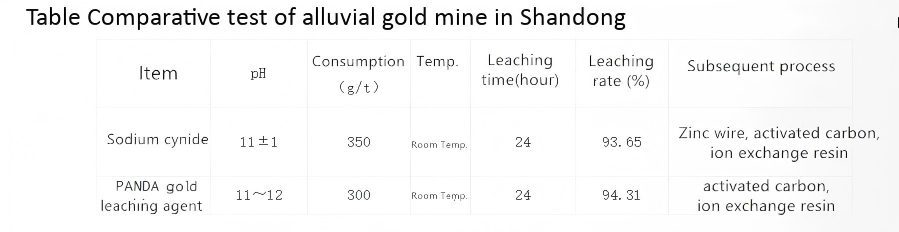
Test 1: Linyi Gold Mine, Shandong (alluvial gold ore)
The raw ore from Linyi had a gold grade of 4.61g/t. The comparative results demonstrate the high efficiency of the FKN agent in standard alluvial gold ore.
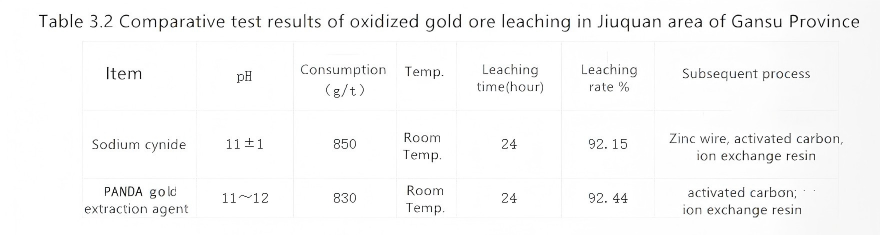
Test 2: Jiuquan Gold Mine, Gansu (High-Grade alluvial gold ore)
Using alluvial gold ore (9.30g/t Au) from Jiuquan, the test aimed to see how both reagents handled richer deposits. The PANDA agent maintained a superior leaching performance.
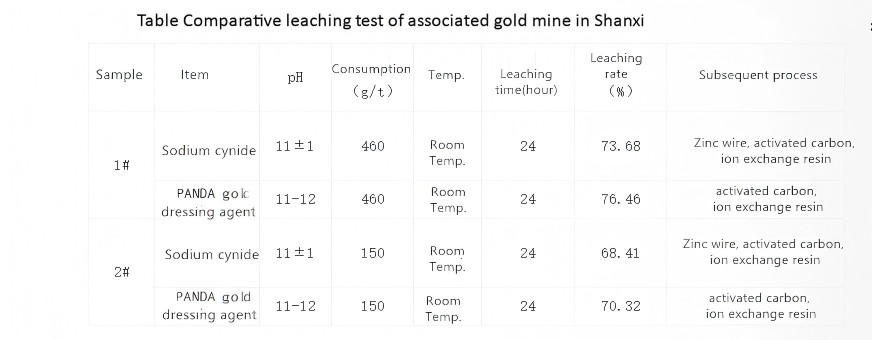
Test 3: Yangquan Gold Mines, Shanxi (Low-Grade associated gold Ore)
This experiment utilized two different low-grade associated gold ore samples (1.09g/t and 0.43g/t Au) to test sensitivity. The results showed that PANDA is highly effective even in lower-grade ores, maximizing recovery where margins are tight.
Test 4: Yuxi Gold Mine, Yunnan (Rock Gold Ore)
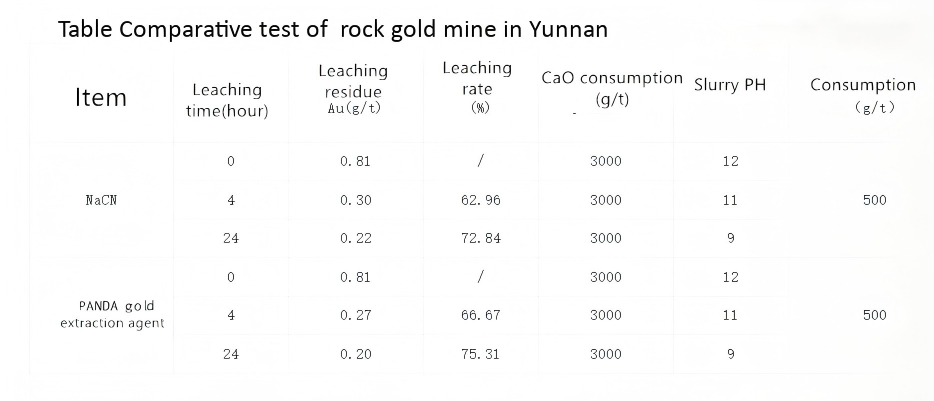
Finally, rock gold ore from Yunnan (0.81g/t Au) was tested. Consistent with previous results, the PANDA agent delivered a leaching rate that met or exceeded that of sodium cyanide.
Conclusion: A Superior Alternative for Modern Mining
The data from these four regional tests leads to a clear conclusion: the PANDA environmentally friendly gold extraction agent not only matches but often surpasses the leaching efficiency of sodium cyanide in oxidized gold ores. With a similar dosage requirement but significantly lower safety risks and environmental impact, PANDA offers a cost-effective, compliant, and high-performance solution for the modern gold mining industry.
Related Catalogues:
Related Products:
Related Solutions:
GOLD RECOVERY OPTIMIZATION SYSTEM
CYANIDE MANAGEMENT & ENVIRONMENTAL COMPLIANCE SYSTEM
FAQ for A Comparative Study on Gold Leaching Efficiency
1. Can PANDA environmentally friendly agent completely replace sodium cyanide in leaching alluvial gold ores?
Yes. Comparative tests conducted on alluvial gold ore from Shandong show that FKN can completely replace sodium cyanide. In many cases, the leaching effect of the PANDA agent was found to be better than that of sodium cyanide, with a similar dosage requirement (0.1% concentration in tests).
2. Is the PANDA gold extraction agent safe to transport and store?
Absolutely. Unlike sodium cyanide, PANDA is non-toxic and non-hazardous. It has been certified by the Shanghai Chemical Industry Research Institute as having no explosion, flammability, or toxicity hazards. It can be transported safely by road, railway, sea, and air without the strict security controls required for dangerous goods.
3. How does the leaching speed of PANDA compare to traditional cyanide?
The PANDA agent is designed for efficiency. In addition to offering a higher or comparable leaching rate, it features a faster leaching time compared to sodium cyanide. This allows for shorter processing cycles and improved throughput in gold beneficiation plants.
4. What is the chemical basis of the PANDA environmentally friendly gold agent?
PANDA is an innovative product developed using the integration technology of polysulfide radicals and amine radicals. This unique formulation allows it to effectively dissolve gold from oxidized and semi-oxidized ores without the use of highly toxic cyanide compounds.
5. Does using PANDA require complex operational changes or specialized training?
No. One of the key advantages of the PANDA agent is its simplicity. The usage process is straightforward and easy to master, making it a user-friendly alternative for mine operators looking to transition away from the strict handling protocols of sodium cyanide.